Curiosity is not a personality trait that some children are born with and others are not. It is a habit - one that is built or diminished by the environment a child grows up in. Research consistently shows that curious children learn faster, perform better academically, and develop stronger resilience than less curious peers. This guide explains eight practical habits that build curiosity in children aged 3–10, and what parents in India can do starting today.
Why curiosity matters more than most parents realise
A 2019 study published in the journal Pediatrics tracked over 6,200 children from birth to school age and found that curiosity - measured as eagerness to learn and openness to new information - was as strong a predictor of academic achievement as early literacy and numeracy skills. Curious children ask more questions, make more connections, and persist longer when problems are difficult.
More importantly, curiosity is intrinsically motivating. A child who is genuinely curious about something does not need to be pushed to learn about it. This is why building curiosity in early childhood is one of the highest-leverage investments a parent can make - it reduces the need for external motivation as a child grows.
What kills curiosity in young children
Before the eight habits, it helps to understand what undermines curiosity - because many of these are common patterns in Indian households with the best intentions:
- Dismissing questions as inconvenient or silly. When a child's question is waved away, they learn quickly that questions are not welcome.
- Always providing the answer immediately. The moment of not-knowing is where curiosity lives. Answering too fast closes that window.
- Environments focused entirely on performance and correctness. Curiosity requires the freedom to be wrong, to explore without a predetermined right answer.
- Excessive passive screen time. Passive consumption does not require curiosity - it replaces it.
The 8 habits
1. Say I do not know - and find out together
When your child asks a question you cannot answer, resist the temptation to guess or deflect. Instead, say: that is a great question, I am not sure - how do we find out? Then actually find out together. This models the most important curiosity habit of all: that not-knowing is the beginning of learning, not a failure.
2. Ask wondering questions
I wonder questions are uniquely powerful for building curiosity. I wonder why the sky turns orange at sunset. I wonder what would happen if it rained upwards. I wonder who built this road and how long it took. These questions are not tests - they are invitations to think. Children who hear adults wonder aloud begin to wonder themselves.
3. Follow their interests - even the unexpected ones
A child obsessed with trucks, insects, or ancient Egypt is demonstrating curiosity in action. The topic does not matter - the habit of deep interest does. Feeding that interest with books, conversations, and experiences communicates that curiosity is rewarded, which makes them more likely to apply it to new domains.
4. Let them be bored
Boredom is the birthplace of curiosity. A child who is never bored never has to generate their own interest - which is the skill curiosity depends on. Scheduled, device-free unstructured time - even if the child initially resists - creates the conditions where curiosity emerges naturally.
5. Visit new places regularly
New environments trigger curiosity automatically. Museums, markets, construction sites, farms, libraries - any environment that differs from the child's ordinary experience activates the brain's novelty-detection systems and generates natural questions. You do not need to explain everything. Being present and curious alongside your child is enough.
6. Celebrate questions more than answers
In most Indian classrooms, correct answers are rewarded. At home, you can create a different culture - one where the quality of the question is what earns attention and enthusiasm. That is a brilliant question. I had never thought about that. How would we even begin to find out? These responses train children to value their own curiosity.
7. Read non-fiction together
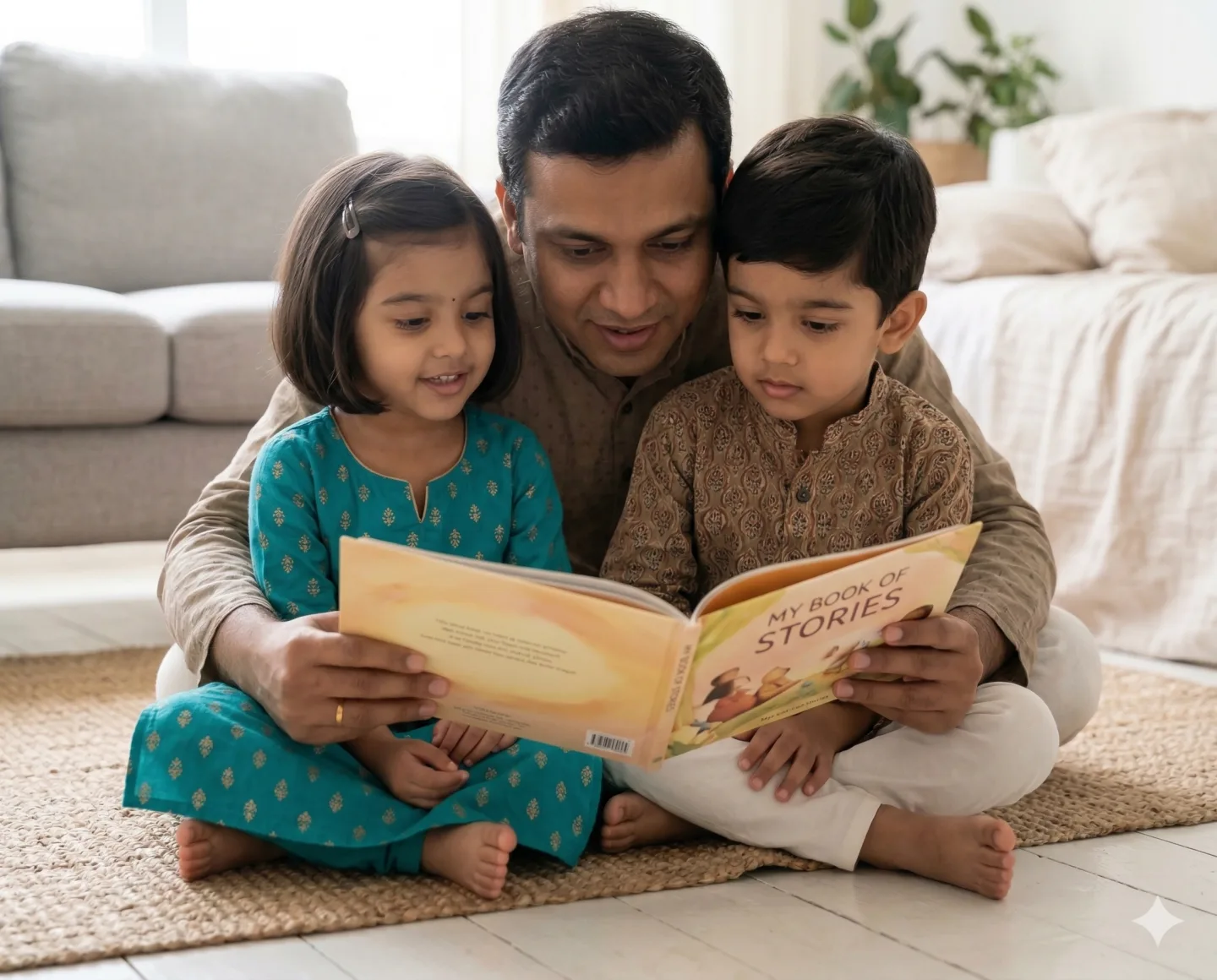
Fiction builds empathy and language. Non-fiction builds curiosity about the real world. Children's non-fiction books on science, history, animals, and how things work are among the most powerful curiosity tools available. Reading non-fiction together - pausing to discuss, question, and connect - models the habit of inquiry that underlies all learning.
8. Use daily curiosity conversations
Apps and tools built specifically to activate and sustain curiosity through adaptive conversation follow a child's interests, ask open-ended questions, and introduce ideas that stretch thinking without prescribing answers. Daily 10–15 minute sessions build the questioning habit in a low-pressure, enjoyable format - making curiosity a daily practice rather than an occasional event.
Key insight: Curiosity is not fixed at birth. It is shaped by experience. Every time a parent takes a child's question seriously, follows up with genuine interest, or models their own curiosity, they are building neural pathways that make the child more likely to approach the world with openness and inquiry.
How curiosity connects to academic performance
The connection between curiosity and school performance is not just correlational - it is mechanistic. Curious children ask for help when confused, which means they understand more. They make connections across subjects, which means learning compounds. They persist when problems are hard, which means they develop mastery. And they find intrinsic reasons to engage with material, which reduces the dependence on external rewards that makes learning feel like a chore.
| Age | How curiosity shows up | How to feed it |
|---|---|---|
| 3–4 years | Endless why and what questions | Answer with wonder, not just facts |
| 4–6 years | Deep interest in specific topics | Follow the obsession; provide books and experiences |
| 6–8 years | Questions about fairness and how things work | Discuss, debate, investigate together |
| 8–10 years | Begins self-directed research | Give access to books and structured exploration |