Critical thinking does not require a curriculum. For children aged 3–8, it requires games - activities that feel like play but demand reasoning, prediction, comparison, and evaluation. The seven games below are chosen specifically because they are easy to play anywhere, require no special materials, and produce genuine cognitive benefits that carry forward into school performance and everyday decision-making.
Why games work for critical thinking
Games create a low-stakes environment for high-stakes thinking. When a child makes a wrong prediction in a game, the consequence is losing a round - not a bad mark or a disappointed adult. This safety is essential. Critical thinking requires willingness to be wrong, to try again, and to update one's approach based on new information. Games are one of the few environments where children naturally do all three without resistance.
The 7 games
1. 20 Questions (ages 4+)
One player thinks of an object. The other asks yes/no questions to identify it within 20 questions. Every question must eliminate as many possibilities as possible. Children naturally move from random questions to strategic ones as they play more - and watching that transition happen is watching critical thinking develop in real time. Start with a limited category such as I am thinking of an animal for younger children.
2. The Odd One Out (ages 3+)
Present three or four objects, images, or words. Ask: which one does not belong and why? The magic of this game is that there is rarely one correct answer - a child can usually justify multiple choices with sound reasoning. This means the game rewards reasoning quality, not answer recall. By age 6, you can play with more abstract categories and challenge the child to defend their choice.
3. What Happens Next? (ages 3+)
Pause any story, show, or real-life event and ask: what do you think will happen next, and why? This is causal reasoning - the ability to understand cause and effect well enough to predict consequences. The why is essential: a guess without reasoning is random, but a guess with an explanation is critical thinking.
4. The Sorting Game (ages 3+)
Give your child a collection of objects and ask them to sort them into groups. Then ask: can you sort them a different way? The challenge of re-sorting requires flexible thinking - the ability to release one category and construct another. A child who can sort the same objects by colour, then by size, then by use is demonstrating cognitive flexibility, which is one of the core components of critical thinking.
5. Strategy board games (ages 4+)
Snakes and Ladders teaches probability. Ludo teaches planning and decision-making. Connect Four teaches forward planning and blocking. Even simple card games like Snap develop attention and pattern recognition. The key feature shared by all strategy games is that outcomes depend partly on the player's decisions - which means the child must evaluate options rather than relying on chance alone.
6. The What Would You Do game (ages 4+)
Present a scenario with no single right answer: you find a wallet on the ground with money in it - what would you do? Your friend is sad but says they are fine - what would you do? This game builds ethical reasoning, empathy, and decision-making simultaneously. There is no correct answer - the goal is to hear the child's reasoning and gently extend it: what might happen if you did that? Is there another option?
7. Build and explain (ages 3+)
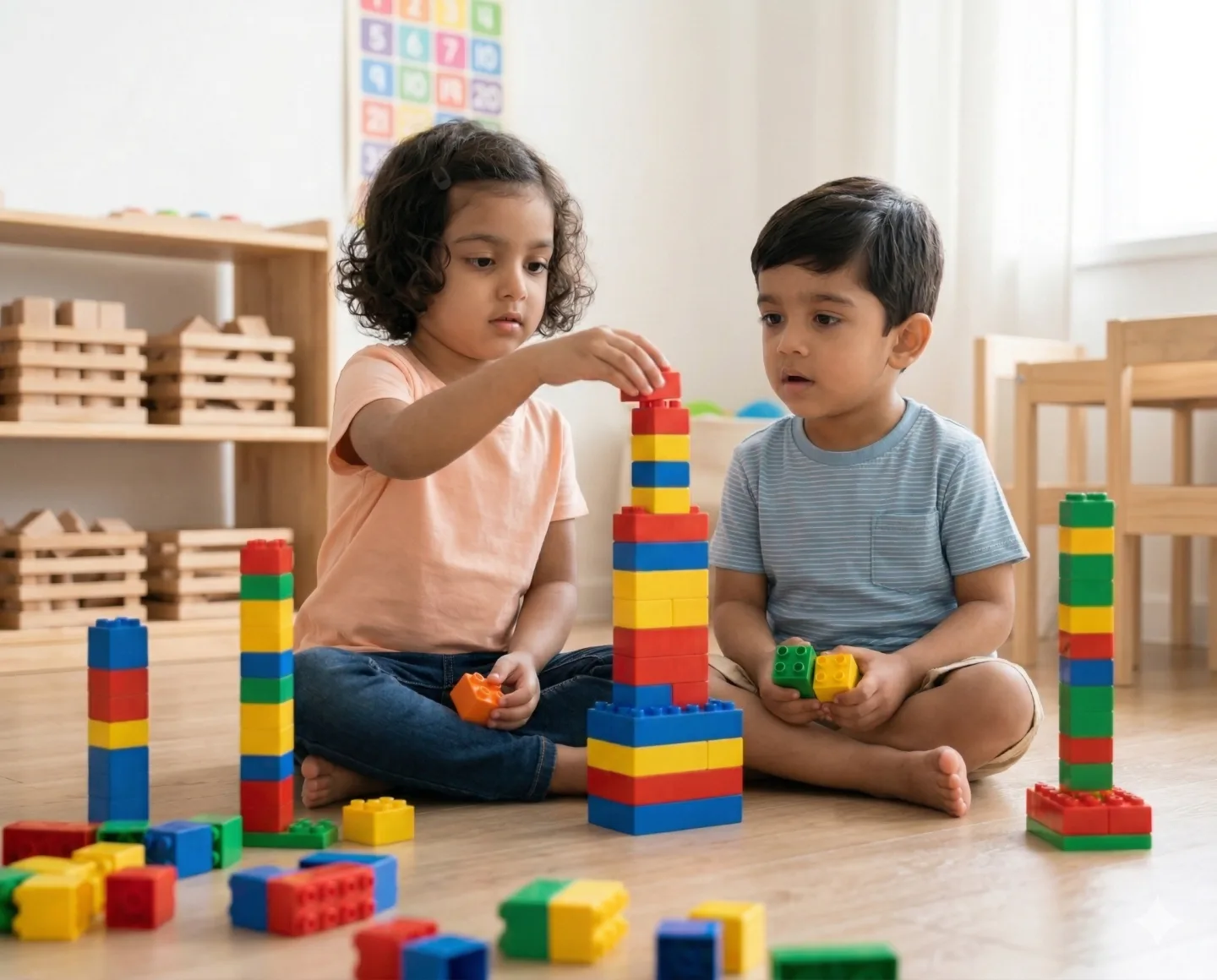
Give your child building materials - blocks, LEGO, cardboard boxes - and a challenge: build the tallest tower that will not fall. Then ask them to explain what they built and why they made their choices. The explanation is the critical thinking exercise. Children who can articulate the reasoning behind their construction decisions are practicing scientific and logical reasoning in its most natural form.
Key insight: The best critical thinking games share one feature - they require the child to explain their reasoning, not just produce an answer. The explanation is where the thinking happens.
Making games a habit
The developmental benefits of thinking games compound with frequency. A single game of 20 Questions produces a moment of reasoning. A hundred games over a year builds a reasoning habit. The goal is not to play these games intensively, but to weave them into ordinary daily life - in the car, at mealtimes, during walks. Ten minutes of thinking play every day will produce measurably different outcomes over a year than an occasional enrichment class.