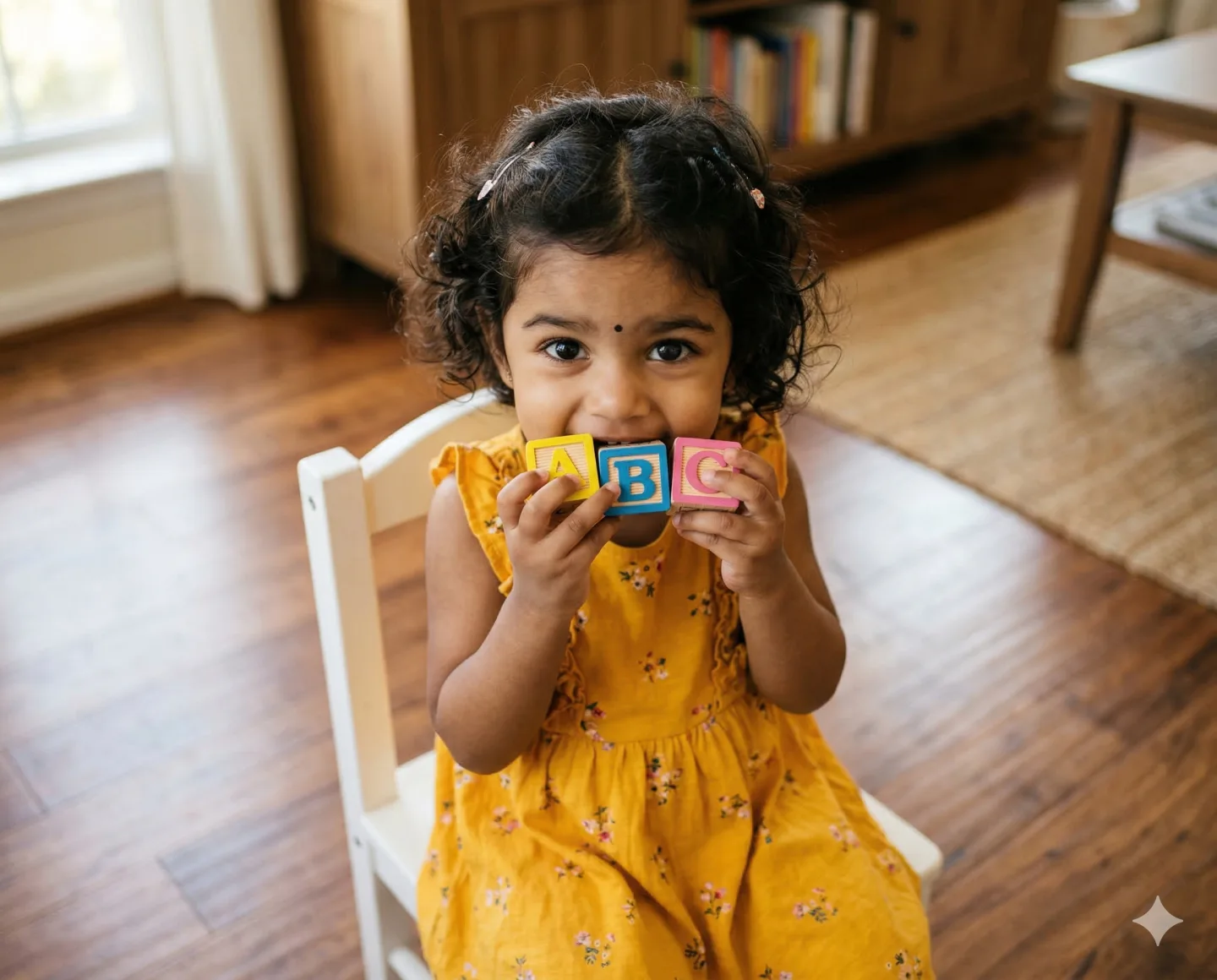
Speaking skills are the single most reliable predictor of a child's long-term academic success - yet most Indian parents spend far more energy worrying about maths worksheets and alphabet tracing than they do about whether their child can express a thought clearly. This guide explains why verbal ability matters more than early academics for children aged 3–8, and what you can do about it starting today.
What are speaking skills, and why do experts prioritise them?
Speaking skills refer to a child's ability to express thoughts, ask questions, tell stories, and engage in back-and-forth conversation. They are not the same as pronunciation or grammar - a child can have perfect diction and still struggle to communicate meaningfully.
According to the World Health Organization's child development framework, communication and language form the foundation on which all other learning is built. Before a child can read, write, or solve problems, they must first be able to process and express ideas verbally. Researchers at Harvard's Centre on the Developing Child describe language development in the first eight years as a "serve and return" process - every time a child speaks and an adult responds, new neural connections form in the brain.
Key insight: Children who can articulate their thinking at age 5 are significantly more likely to read at grade level by age 8, according to longitudinal studies from the National Literacy Trust (UK).
The research: how verbal ability predicts academic and career outcomes
The evidence connecting early speaking skills to later success is remarkably consistent across cultures, including India.
- Vocabulary size at age 3 predicts reading comprehension at age 11 better than any other single measure, according to research published in the journal Child Development.
- Children who speak confidently in early childhood are more likely to participate actively in class, ask for help when confused, and build stronger relationships with teachers - all of which compound over years of schooling.
- A 2022 McKinsey report on India's education outcomes identified oral communication as one of the top five skills most lacking among school graduates entering the workforce - a gap that begins well before school age.
- In competitive environments like IIT entrance coaching and MBA programmes, the ability to communicate complex ideas clearly is consistently rated as a stronger differentiator than raw academic scores.
Speaking vs. rote learning: what Indian parents should know
The Indian education system has historically emphasised memorisation, repetition, and written output. This produces children who can recite multiplication tables but struggle to explain what multiplication means. It produces students who can write essays but freeze in group discussions.
This is not a criticism of academic preparation - it is a recognition that speaking ability and academic knowledge are separate skills, and that speaking is routinely under-invested in during the years when it matters most.
The ideal approach is not to replace academics with speaking practice. It is to give both equal attention during the foundational years of 3–8, when the brain is most receptive to language development.
How speaking skills develop from ages 3 to 8
Understanding the developmental stages helps parents calibrate their expectations and identify early gaps.
| Age | Typical speaking ability | What to watch for |
|---|---|---|
| 3–4 | Simple sentences, 3–4 word phrases, lots of questions | Difficulty forming sentences, limited vocabulary |
| 4–5 | Stories with beginning and end, can describe events | Cannot stay on topic, hard to understand at home |
| 5–6 | Explains reasoning, uses connecting words (because, but, so) | Avoids speaking in groups, frequently interrupted by others |
| 6–8 | Argues a point, adjusts language for different audiences | Relies on single words or gestures instead of sentences |
What happens when speaking confidence is ignored early
Children who do not develop confident speaking habits in their early years often show a predictable pattern: they become passive learners. They listen but do not question. They complete tasks but do not problem-solve aloud. They avoid situations where they might be wrong in public.
This passivity hardens with age. By the time a child reaches secondary school, underdeveloped communication skills show up as reluctance to ask questions in class, poor performance in group work and presentations, and low confidence in social settings. Reversing these patterns at 14 is possible but significantly harder than addressing them at 4.
How parents can nurture speaking skills at home
You do not need a tutor, a classroom, or expensive materials. You need consistent, intentional conversation.
- Ask open questions. Instead of "Did you like school today?" try "What was the most interesting thing that happened today?" Open questions require more than a yes or no, which means more practice forming sentences.
- Narrate your day together. While cooking or commuting, talk through what you are doing and why. Ask your child to narrate it back. This builds vocabulary in a natural, pressure-free context.
- Tell stories - and ask for stories. Bedtime storytelling is not just comfort; it is one of the most effective language-building activities available. Ask your child to make up the ending.
- Resist the urge to complete their sentences. When a child pauses to find the right word, the instinct is to help. Resist it. That pause is the brain working hard to build a connection.
- Create a safe audience. Children practice speaking more when they feel they will not be judged or corrected. Prioritise warmth over correction in everyday conversation.