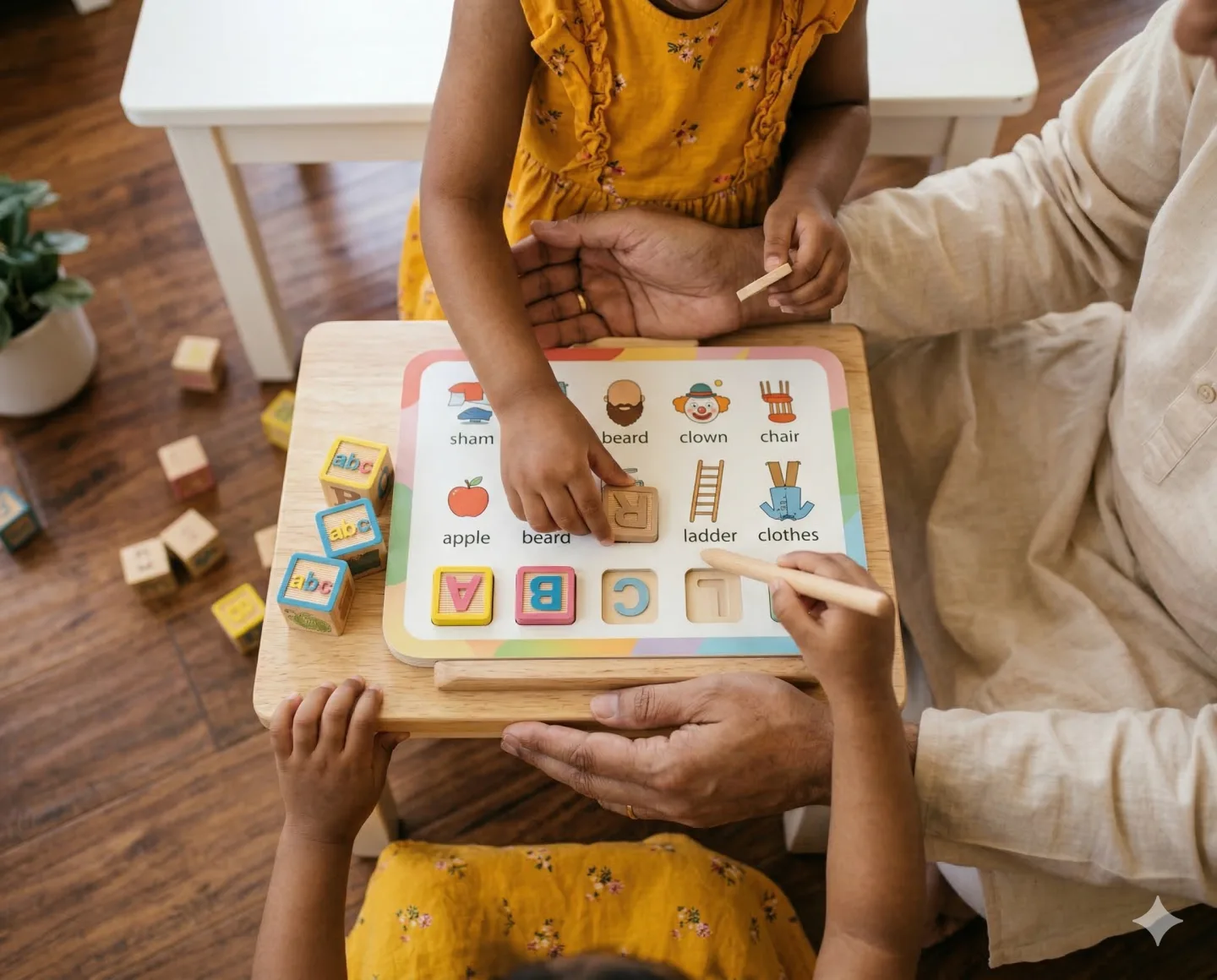
Language development in children is the process by which they acquire the ability to understand and use words, sentences, and conversation. It begins before birth - babies respond to their mother's voice in the womb - and continues actively through the first decade of life. Understanding the key stages, what is typical at each age, and which signs warrant attention can help Indian parents support their child's growth and catch issues early.
What is language development?
Language development encompasses two interconnected abilities. Receptive language is the ability to understand what is said - following instructions, recognising words, understanding stories. Expressive language is the ability to produce language - speaking words, forming sentences, telling a story or explaining a feeling.
Both develop simultaneously, though receptive ability typically runs ahead. A two-year-old usually understands far more than they can say. When parents assume their child's language is limited because they do not talk much, they often underestimate how much is already being processed internally.
Why language development matters beyond vocabulary
Language is not just communication - it is the primary medium through which children think. Psychologist Lev Vygotsky demonstrated in his foundational research that inner speech - the internal language we use to reason and plan - develops directly from the spoken conversations a child has in early childhood.
This means a child with a rich spoken language environment does not just speak better. They think better. They problem-solve, self-regulate, and learn academic content more effectively because language is the scaffolding that supports all of those abilities.
Language development stages: what to expect at each age
Ages 0–1: Pre-language and babbling
In the first year, babies develop the building blocks of language without producing a single word. They track faces, respond to tone, take turns in "conversations" of sounds and expressions, and begin to associate specific sounds with meaning. By 12 months, most babies say their first recognisable word.
Ages 1–2: First words and two-word combinations
Between 12 and 24 months, vocabulary grows from 1–3 words to 50 or more. By age 2, most children begin combining two words ("more milk", "daddy go"). They understand simple instructions and respond to their own name reliably.
Ages 2–3: Sentence building and questioning
This is often called the "language explosion" phase. Vocabulary can grow by 8–10 new words per day. Children begin forming three and four word sentences, asking "what" and "where" questions, and using pronouns. By age 3, strangers should be able to understand roughly 75% of what a child says.
Ages 3–5: Complex language and storytelling
Children begin to tell stories with a beginning, middle, and end. They ask "why" and "how" questions constantly (a sign of active reasoning, not just curiosity). Grammar becomes more complex, including past tense and plurals. By age 5, most children can hold a sustained conversation with an adult on a topic they are interested in.
Ages 5–8: School language and metalinguistic awareness
Children develop the ability to think about language itself - understanding that words have multiple meanings, that the same idea can be expressed differently, and that context changes how we communicate. This underpins reading comprehension, written expression, and social communication.
Language milestones at a glance
| Age | Typical milestone | Possible concern if absent |
|---|---|---|
| 12 months | 1–3 words, responds to name | No babbling, not responding to sounds |
| 18 months | 10–20 words, points to objects | Fewer than 6 words, not pointing |
| 2 years | 50+ words, two-word phrases | No two-word combinations |
| 3 years | 200+ words, short sentences | Strangers cannot understand speech |
| 4 years | Tells stories, asks why/how | Cannot maintain a topic in conversation |
| 5 years | Clear grammar, extended conversation | Difficulty following multi-step instructions |
Red flags: when to seek professional advice
The milestones above represent typical ranges, not rigid deadlines. However, some patterns consistently warrant a conversation with a speech-language pathologist or paediatrician.
- No babbling by 12 months
- No single words by 16 months
- No two-word combinations by 24 months
- Loss of previously acquired language skills at any age
- Difficulty understanding simple instructions by age 2
- Speech that is largely unintelligible to strangers at age 3
- Avoidance of conversation or marked reluctance to speak in familiar settings by age 4
Early intervention for language delays is significantly more effective than late intervention. If you are concerned, trust your instinct and seek a professional opinion.
How to support language development at home
The most powerful thing an Indian parent can do for their child's language development costs nothing: talk to them. Specifically:
- Read aloud daily. Even 10–15 minutes of shared reading exposes children to vocabulary they would never encounter in everyday conversation.
- Have meals without screens. Family conversation at mealtimes is one of the richest language environments a child can experience. Harvard research links family meals directly to stronger vocabulary in children.
- Follow their lead. When a child shows interest in something - an insect, a vehicle, a character in a story - pursue that topic in conversation. Interest-led conversation builds vocabulary twice as fast as instruction-led conversation.
- Use both languages confidently. In multilingual Indian households, bilingualism is a cognitive advantage, not a confuser. Use both languages freely and naturally.